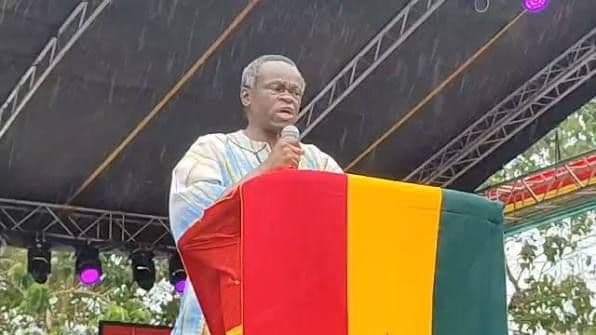
Kenyan scholar and Pan-Africanist Professor Patrick Lumumba has called for renewed efforts to unite Africa and complete what he described as the unfinished work of Ghana’s first President, Osagyefo Dr. Kwame Nkrumah.
Prof. Lumumba made the call at NKRUMAHFEST 2026, held at Nkroful on September 19, 2026, under the theme, “Nkrumah @117: Celebrating His Enduring Legacy – Africa Must Unite or Perish.”
The event brought together traditional leaders, government officials, members of the Nkrumah family, academics, Pan-Africanists and other participants to commemorate the 117th anniversary of Dr. Nkrumah’s birth and reflect on his contribution to Ghana, Africa and the global Black community.
Prof. Lumumba mentioned that Nkrumah’s significance extended beyond Ghana because he linked Ghana’s independence to the liberation and unity of the entire African continent.
Nkrumah Linked Ghana’s Freedom to Africa’s Liberation
Prof. Lumumba noted that although several African countries had achieved independence before Ghana, Nkrumah was among the first African leaders to explicitly connect Ghana’s independence with the liberation of the rest of the continent.
He said Nkrumah’s declaration that Ghana’s independence would have little meaning if Africa remained under colonial rule transformed Ghana into a centre for African liberation movements.
According to him, leaders including Julius Nyerere, Kenneth Kaunda, Hastings Banda, Jomo Kenyatta, Ahmed Sékou Touré, Nelson Mandela, Sam Nujoma, Agostinho Neto, Amílcar Cabral and others were part of a wider liberation struggle that Nkrumah actively supported.
He added that prominent figures from the African diaspora, including W.E.B. Du Bois, George Padmore and Martin Luther King Jr., also recognised the significance of Nkrumah’s Pan-African vision.
“The Work Started by Nkrumah Is Incomplete”
Prof. Lumumba said Nkrumah should not be remembered merely through annual commemorations but through efforts to address the challenges confronting Africa.
“We are not here simply to memorialize the Osagyefo Kwame Nkrumah. We are not here simply to remember the Osagyefo Kwame Nkrumah. We are not here just for an annual jamboree. We are here because we know that the work that was started by Kwame Nkrumah is incomplete,” he stated.
He cited conflicts, insecurity, migration, poverty, weak industrial capacity and dependence on foreign technology as some of the challenges that continue to confront the continent.
Prof. Lumumba argued that Nkrumah’s vision of an integrated and self-reliant Africa remained relevant to contemporary challenges.
Africa Must Build Its Own Capacity
Prof. Lumumba said Africa must strengthen its capacity to produce essential goods, develop technology and use its natural resources to improve the living standards of its people.
He questioned Africa’s continued dependence on foreign countries for medicines, food, technology and information about its own affairs.
“When we are sick, we do not make medicine to cure ourselves. The Osagyefo wanted us to do so. When we are hungry, sometimes we cannot feed ourselves. The Osagyefo looked to the day when our agriculture would give us the food to feed ourselves,” he said.
He also referenced Nkrumah’s vision for an independent African media system, arguing that African countries should have stronger capacity to tell their own stories.
“We Are Still 54 Countries With 54 Passports”
Prof. Lumumba further highlighted the continued fragmentation of the African continent, noting that Africans still face barriers to movement across countries.
He pointed that the existence of separate passports and telephone country codes as examples of the practical limitations to continental integration.
“We are disunited. We are still 54 countries with 54 passports. We still need visas to travel to countries within the continent of Africa,” Prof. Lumumba stressed.
He, however, noted developments such as the African Continental Free Trade Area and Africa Agenda 2063 as efforts toward deeper continental integration.
He said the long-term objective should be an Africa capable of producing and consuming more of its own goods and reducing dependence on external markets.
Calls for Stronger African Unity
Prof. Lumumba asserted that Nkrumah’s call for African unity remained particularly relevant amid conflicts and insecurity on the continent.
He referenced conflicts in Somalia, Sudan and Cameroon, as well as insecurity in the Sahel, arguing that lasting development would be difficult without peace and cooperation.
“I wish that all who have the honor and privilege of serving Africa in various capacities would wake up to the realization that in the absence of peace Africa can never prosper,” he argued.
He called on African political leaders to work toward common positions on issues affecting the continent and to prioritise the interests of African populations.
“Forward Ever, Backward Never”
Prof. Lumumba said the younger generation had an important role to play in preserving and advancing Nkrumah’s legacy.
He noted that Nkrumah’s ideas continue to influence discussions on African unity, governance, education, industrialisation and development decades after his death.
“You asked us and told us that you lit a light. We are lighting that light,” he highlighted.
He said Africa must strengthen its universities, improve the management of its resources, develop its technological capacity and create conditions that enable young Africans to contribute to the continent’s development.
Prof. Lumumba concluded by reaffirming the need for African unity, self-confidence and collective action, stressing that Africa’s future depends on its ability to overcome fragmentation and build institutions and systems that serve its people.
“We take a solemn vow that no matter how difficult the circumstances, no matter how painful the process, the continent of Africa will rise and play a part in the world,” he remarked.